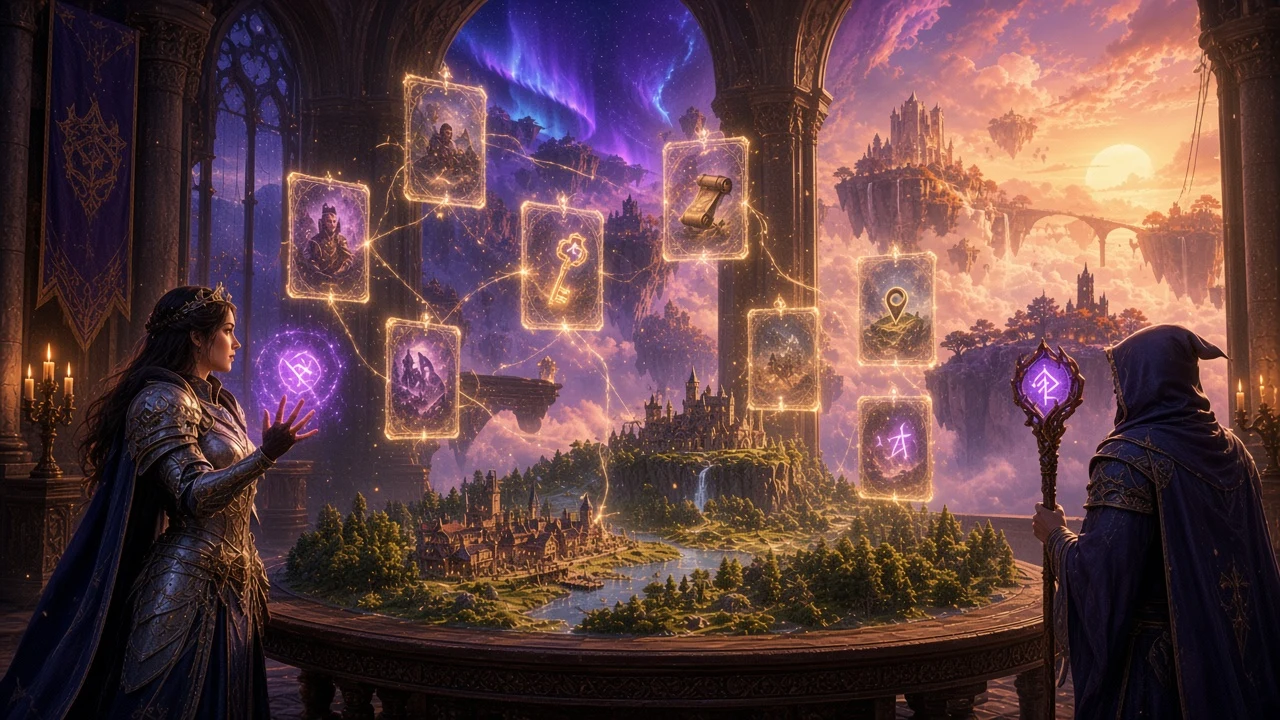
DNDAI 3.0 is our biggest update since 2.0. It rebuilds the Game Master from the ground up, and the short version is this: the world now keeps score. The barkeep you insulted remembers it. The promise you made is written down. The potion you drank is gone, and the sword you were handed is on your sheet before you finish reading the reply. Your spells and abilities run dry until you rest, just like at a real table. Stall, and the danger moves without you. And every time something changes, you see it happen.
- Mara warms to you+1Warm
You paid her debt to the dock boss.
- Promise to Mara
Find her brother before the tide turns.
- Story item gained
The harbourmaster's brass key
In 3.0
- The world remembers you. People, promises, places and companions, all on one World tab
- Your sheet keeps up. What the story gives you lands on it. What it takes leaves it
- Your pack is in reach. Use any item, spell or ability from the game screen, each with its own animation
- Spells and abilities have charges. Spell slots, ki, rages and more, worked out from your sheet, back after a rest
- Stakes that move. Situations instead of scripts, and a threat that closes in when you waste time
- A Game Master that listens. Your thoughts stay yours, table talk works, and failures cost something
- Every reward has a sound. Crisp effects timed to the frame of each card, cast and charge
1. The world remembers you
A card for every change, a tab for everything
Win someone over, make an enemy, find a place, learn a secret, pick up something that matters. The moment it happens, a card like the one above lands under the Game Master's reply. Your four choices stay live beneath it, so it never gets in your way.
It is built to be noticed without shouting. The card rises out of a blur, a beam of light sweeps across it once, and each change slides in after the other. Good news throws sparks. When someone's opinion of you moves, the +1 or −2 floats up and a seven-step meter slides from where they stood to where they stand now. You can read it by colour:
- Green: someone warms to you, a companion grows more loyal, or a promise is kept
- Red: someone turns on you, a companion wavers or leaves, a promise breaks, gear is lost
- Blue: something new you know, a new face, a new place
- Gold: a story item or new gear
- Violet: a spell learned
- Teal: a new ability
- Orange: the danger grows
- Yellow: a personal goal achieved, or something new sticks to your name
The World tab
Everything the story remembers lives next to your character and Campaign Info, behind a new globe. When the world changes while you are not looking, a small blue dot pulses on it. Try it:
- You: where you are, and what sticks to your name, like a bounty, a title or an oath. In a party game every hero gets a card
- Companions: who travels with you, with their loyalty from about to leave to sworn. Treat them well and they take risks for you. Push them too far and they walk away. Loyalty carries over to your next campaign, and someone who left stays gone
- People: everyone who matters, most recent first, each with a mood from hostile to devoted and the last thing that happened between you
- Places, promises (○ open, ✓ kept, ✗ broken), story items and what you know, newest first
This is not a summary written for you. It is the exact record the Game Master plays from. If Voss hates you here, he hates you in the story. Your own heroes and companions are never filed as strangers, and when someone you meet joins you for good, they move from People to Companions and keep their history with you.
2. Your sheet keeps up with the story
What the story gives you, you get. What it takes, you lose
Loot a chest and the cutlass is yours, right there in the same reply. A card flashes in first. A moment later the full entry follows, with its dice, bonus and value, already on your sheet. Pick one:
- New gear: Stormglass Cutlass
Pried from the smuggler captain's sea chest.
Writing it onto your sheet…
- Each kind has its own colour: gold for gear, violet for spells, teal for abilities and green for a new companion
- Give any new entry its own art straight from the card: an image for a sword or a spell, or a portrait, short video or 3D avatar for a new companion
- You only get what you really got. Push the bribe back, fail the roll on the lock, or just admire the sword on the wall, and your sheet stays as it was
- In party games the card says whose hero got it, and only that hero's sheet changes
And when things leave your pack
Hand a potion to a wounded friend, drink it, or pay with your silver ring, and a red card shows what left your pack. A stack loses one at a time. The last one is not deleted: it moves to No longer carried on your sheet, marked Used with what happened to it, so the art you made for it is never lost. Win it back in the story and it is in your pack again, pictures and all. Spells and abilities never leave your sheet: casting one spends a charge instead (more on that below).
Nothing slips through
Storytellers get carried away. A Game Master can describe the herald handing you a knife and forget to put it on your sheet. So after every turn a second, quick reader checks the story against your sheet. If a dagger changed hands, a potion was drunk or a companion was sent on their way, it catches it, and your sheet follows the story you actually read.
3. Reach into your pack
Use anything you carry, and watch it happen
Above the message box sits a new Gear button, with your most likely picks next to it, healing first. Open it for every item, spell and ability you have, with search once the list gets long. Tap one, choose who it is for (yourself, a companion or someone you just met), add how if you like, and hit Use now. Or pick Add to my action to finish the sentence yourself. On your phone it slides up from the bottom.
Then it comes to life. Drink the potion, throw a frost bomb until the stack runs out, swing the sword:
Pick anything below and use it.
Gear 13- It looks like what it is. Healing rises in green light, fire throws embers, lightning cracks down onto the card, frost draws a crystal around it, shadows creep in, holy light fans out in rays, a blade cuts across, a shield raises a ward and a quick step blurs past
- It reads your names. The look comes from the name and description, in English or German. Your "Lichtbogen" crackles like lightning and your "Dunkler Trank" swirls with shadow
- Items wait for the story. While the Game Master answers, the item hovers on your Gear button. Kept, it drops back in and the button bounces. Used up, it rises and shatters into pieces of its own picture. From a stack, it tells you how many are left
- If your device asks for reduced motion, everything still works, just without the show
The Game Master knows what you carry too. Your gear, spells and abilities are part of every turn, so the healing potion in your pack can save you, and the spell you learned last week is there when you need it.
4. Spells and abilities have charges
Classic D&D rules, read straight off your sheet
A wizard cannot throw fireballs all day, and now neither can you. Every game tracks your spell slots and the uses of your abilities, worked out from your class, level and race the way the Player's Handbook does it. Cast until you run dry, then find a safe moment to rest:
Cast, smite and heal until something runs dry. Then rest.
- Spell slots follow the 5e tables. A level 5 sorcerer has 9, a level 5 paladin 6, and a warlock's few slots come back on a short rest. Cantrips are free, as often as you like
- Class resources: ki for monks, sorcery points for sorcerers, rages for barbarians, Channel Divinity, Bardic Inspiration, Wild Shape and Blood Maledict, each sized by your level. Second Wind, Action Surge and Lay on Hands keep their own count, and Divine Smite spends a spell slot
- Your race counts too. A dragonborn's Breath Weapon, a tiefling's Hellish Rebuke, a half-orc's Relentless Endurance and about 30 more, marked Racial in your Gear
- Always on is free. Sneak Attack, Darkvision, a fighting style or a skill never run out. A homebrew ability gets as many uses per long rest as your proficiency bonus
- Out of slots as a sorcerer? Two sorcery points buy one more
Getting them back
- Long rest: everything comes back. Once every few scenes, and only when it is safe. Danger can wake you
- Short rest: an hour to catch your breath. Ki, Second Wind, Channel Divinity and a warlock's slots come back. Two between long rests. A wizard's first one also recovers some slots through Arcane Recovery
- No time to rest? A Pearl of Power or a mana potion brings back one slot or one use
- Just ask in the story: "we make camp for the night" or "let's take a breather". Your Game Master knows when you can, and when the threat will not wait
In Gear every spell and ability shows what it has left. An empty one greys out and tells you how to get it back, and a small card above the Gear button counts down each time you cast. The Game Master sees the same numbers, so when you are out, the spell fizzles in the story too.
5. Stakes that move
Situations instead of scripts, and a clock that ticks
Campaigns now play as situations: a place, a problem, and something at stake. There is no script to follow. Talk your way through, sneak past, fight, or find a door nobody wrote down. If what you did solves it, it is solved.
Above them sits the threat: what happens if nobody stops it. Waste a few turns and watch it close in:
Current goal: Find Jory before the smugglers move him.
- 1. A debt at the docksDoneSaltmarket docksGet Mara out from under the dock boss.
- 2. The missing brotherCurrentThe Drowned ChapelFind Jory before the smugglers move him.
- 3. Fire on the waterLocked
- It moves when you give it a reason: you stall, a roll goes badly wrong, or you lose a fight. Good play does not feed it, and a tense scene alone does not tick it
- Each step drops an orange card into the chat with the count, like 4/6. When it fills, the danger happens in the story
- A situation that drags on gets wrapped up. The next real step forward settles it, or it ends with a cost and the story moves on
6. A Game Master that listens
The part you cannot see, but will feel
Under all of this is a new Game Master that reads your turn the way a person at the table would.
- Your reasons stay yours. Write "I search his cart because I think he stole the ring" and the merchant does not suddenly deny stealing a ring. He only hears what you say out loud. Words in quotes, or lines starting with a dash, are speech. Everything else is your character's head
- Talk to the Game Master directly. Put a note in ((double brackets)), [OOC: ...], or start a line with OOC: or //. It is table talk, not something your hero did
- Take it back. Write "rewrite your last post" (in German too) and the last reply is replaced, not continued. That works on the opening scene as well
- Wins land. Failures cost. A clean win ends the scene. A failed roll costs you something real, and the story still moves. No more rolling a 2 and getting what you wanted anyway
- What happened stays true. If the letter burned, it burned. No convenient scrap three turns later
- Your past, at the right time. Your backstory comes up when the scene touches it. Quests from earlier adventures are finished and stay out of the new one
- Always four real choices. The last one is still your free action
7. Every reward has a sound
Every card, cast and charge now has its own sound, and each one is timed to the animation: the hit lands on the exact frame the card snaps into place.
- A card rises with a whoosh, and each row ticks one note higher as it lands, so a card with more news climbs further
- The final chime matches the news: warm when someone warms to you, low when a door closes, a heavy strike when the threat fills up
- An attitude meter counts its steps out loud, up or down
- Every gear effect has its own impact. Fire crackles, frost crystallises, a blade slashes twice, and a potion shatters when it is spent
- Spending a spell slot gives a small, satisfying pip, and the game-start loader ticks off each step as it finishes
- Sound is off until you turn it on with the speaker button in the menu, and it stays quiet if your device asks for reduced motion
Faster, in every language, with friends
- One Game Master reply per turn instead of a chain of them, so turns come back sooner
- Starting a new game shows what is happening right away: your campaign art and hero, each step as it finishes, and how long is left
- Situations, the threat and the World tab are written in your game language, from the opening scene to the last
- In party games the Game Master answers everyone in one reply. Each player's roll counts for their own hero, and a party that splits up stays split up
Who gets it
Every game you start from today. A game that is already running keeps its old Game Master until it ends, so nothing changes under you mid-story. Your characters, campaigns and their story beats carry over as they are.
Your first five minutes
- Start a new game from any campaign
- Be kind to someone. Or don't. Watch the card
- Make a promise, then open the World tab
- Take a reward, and watch your sheet fill in
- Open Gear and drink a potion
- Cast until your slots run dry, then make camp
- Dawdle for a turn or two and keep an eye on the threat
Welcome to DNDAI 3.0. The world is watching.